
from US$22.21
Japan, Ogasawara
Stargazing Tour - Observe the best starry sky in Japan, Ogasawara!
Explore
Explore the profound quiet of the universe through NASA's high-resolution archives. Perfect for your stargazing journey.
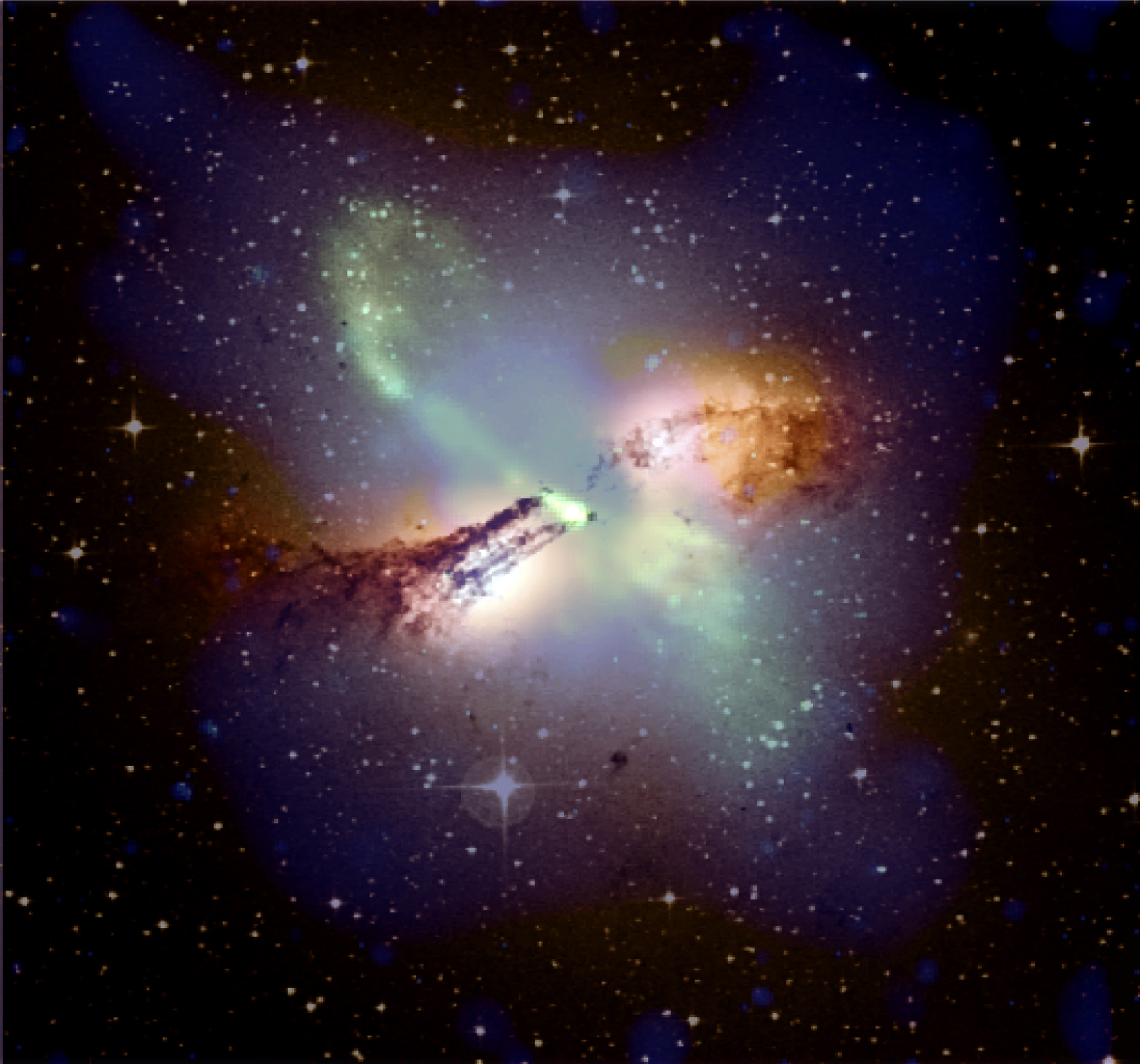
This is a photo taken by NASA's Chandra X-ray Observatory that reveals the remains of an explosion in the form of two enormous arcs of multimillion-degree gas in the galaxy Centaurus A that appear to be part of a ring 25,000 light years in diameter. The size and location of the ring suggest that it could have been an explosion that occurred about 10 million years ago. A composite image made with radio (red and green), optical (yellow-orange), and X-ray data (blue) presents a sturning tableau of a turbulent galaxy. A broad band of dust and cold gas is bisected at an angle by opposing jets of high-energy particles blasting away from the supermassive black hole in the nucleus. Lying in a plane perpendicular to the jets are the two large arcs of x-ray emitting multi-million degree gas. This discovery can help astronomers better understand the cause and effect of violent outbursts from the vicinity of supermassive black holes of active galaxies. The Chandra program is managed by the Marshall Space Flight Center in Huntsville, Alabama.
This particular celestial object, History of Chandra X-Ray Observatory, was captured by NASA's deep space observatories. While its specific historical mythology remains a mystery, objects of this type are crucial for our understanding of cosmic evolution and stellar life cycles.
To observe phenomena similar to this, we recommend using high-contrast filters and a motorized equatorial mount.
Discover nebula-themed journey sites designed for peaceful observation.
Japan, Ogasawara
Stargazing Tour - Observe the best starry sky in Japan, Ogasawara!
ExploreNew Zealand
Small-Group Refined Experience - Stargazing English Tour in Tekapo | New Zealand
ExploreHawaii
Hawaii Big Island: Mauna Kea Stargazing Half-Day Tour with Transfer Service in Waikoloa, Kona, and Hilo
Explore
NASA often uses 'false color' techniques. Scientists map invisible wavelengths (like infrared) or specific gases to visible colors (red, green, blue) to highlight the nebula's structural details.
While some bright nebulas are visible with entry-level telescopes, capturing these stunning details usually requires deep-sky astrophotography equipment and long exposures.


