
from US$22.21
Japan, Ogasawara
Stargazing Tour - Observe the best starry sky in Japan, Ogasawara!
Explore
Explore the profound quiet of the universe through NASA's high-resolution archives. Perfect for your stargazing journey.
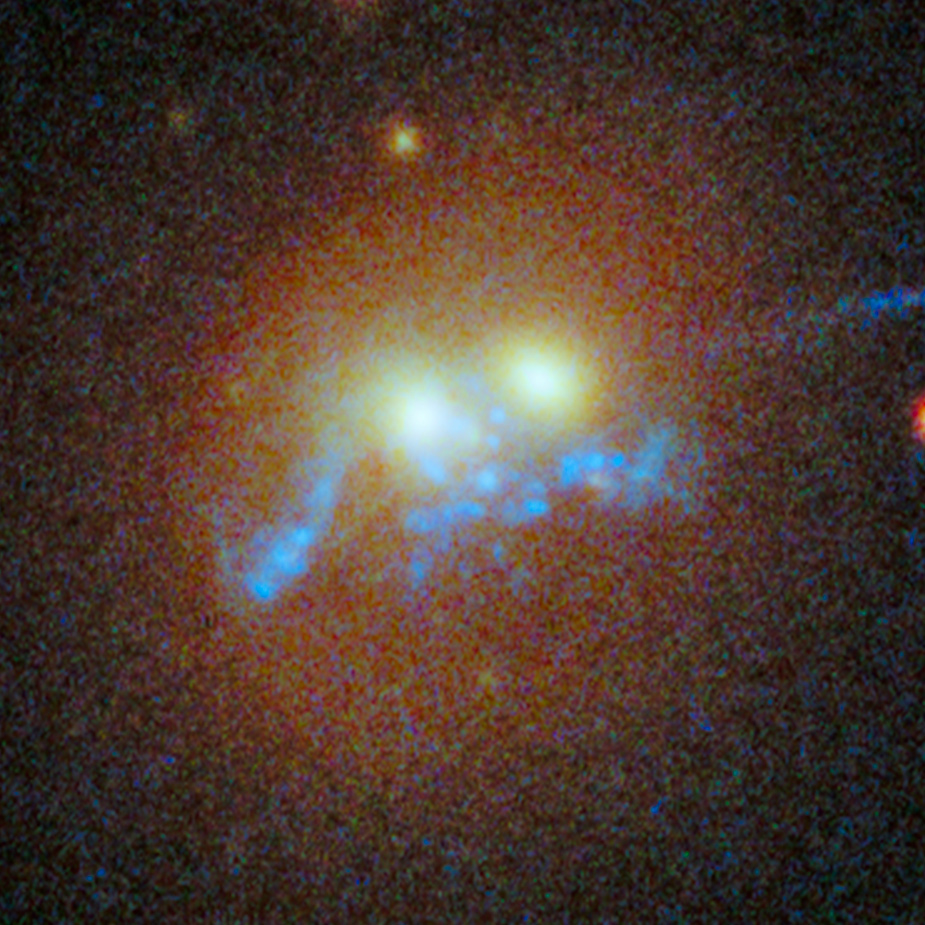
NASA's Hubble Space Telescope has photographed the dense galaxy cluster SDSS J1531+3414 in the northern constellation Corona Borealis. Made up primarily of giant elliptical galaxies with a few spirals and irregular galaxies thrown in for good measure, the cluster's powerful gravity warps the image of background galaxies into blue streaks and arcs. At the center of the bull's-eye of blue, gravitationally lensed filaments lies a pair of elliptical galaxies that are also exhibiting some interesting features. A 100,000-light-year-long structure that looks like a string of pearls twisted into a corkscrew shape winds around the cores of the two massive galaxies. The "pearls" are superclusters of blazing, blue-white, newly born stars. These super star clusters are evenly spaced along the chain at separations of 3,000 light-years from one another. Read more: 1.usa.gov/1ztQvL9 Credit: NASA/ESA NASA image use policy. NASA Goddard Space Flight Center enables NASA’s mission through four scientific endeavors: Earth Science, Heliophysics, Solar System Exploration, and Astrophysics. Goddard plays a leading role in NASA’s accomplishments by contributing compelling scientific knowledge to advance the Agency’s mission. Follow us on Twitter Like us on Facebook Find us on Instagram
This particular celestial object, Hubble Sees Spiral Bridge of Young Stars Between Two Ancient Galaxies, was captured by NASA's deep space observatories. While its specific historical mythology remains a mystery, objects of this type are crucial for our understanding of cosmic evolution and stellar life cycles.
To observe phenomena similar to this, we recommend using high-contrast filters and a motorized equatorial mount.
Discover nebula-themed journey sites designed for peaceful observation.
Japan, Ogasawara
Stargazing Tour - Observe the best starry sky in Japan, Ogasawara!
ExploreNew Zealand
Small-Group Refined Experience - Stargazing English Tour in Tekapo | New Zealand
ExploreHawaii
Hawaii Big Island: Mauna Kea Stargazing Half-Day Tour with Transfer Service in Waikoloa, Kona, and Hilo
Explore
NASA often uses 'false color' techniques. Scientists map invisible wavelengths (like infrared) or specific gases to visible colors (red, green, blue) to highlight the nebula's structural details.
While some bright nebulas are visible with entry-level telescopes, capturing these stunning details usually requires deep-sky astrophotography equipment and long exposures.


