
from US$22.21
Japan, Ogasawara
Stargazing Tour - Observe the best starry sky in Japan, Ogasawara!
Explore
Explore the profound quiet of the universe through NASA's high-resolution archives. Perfect for your stargazing journey.
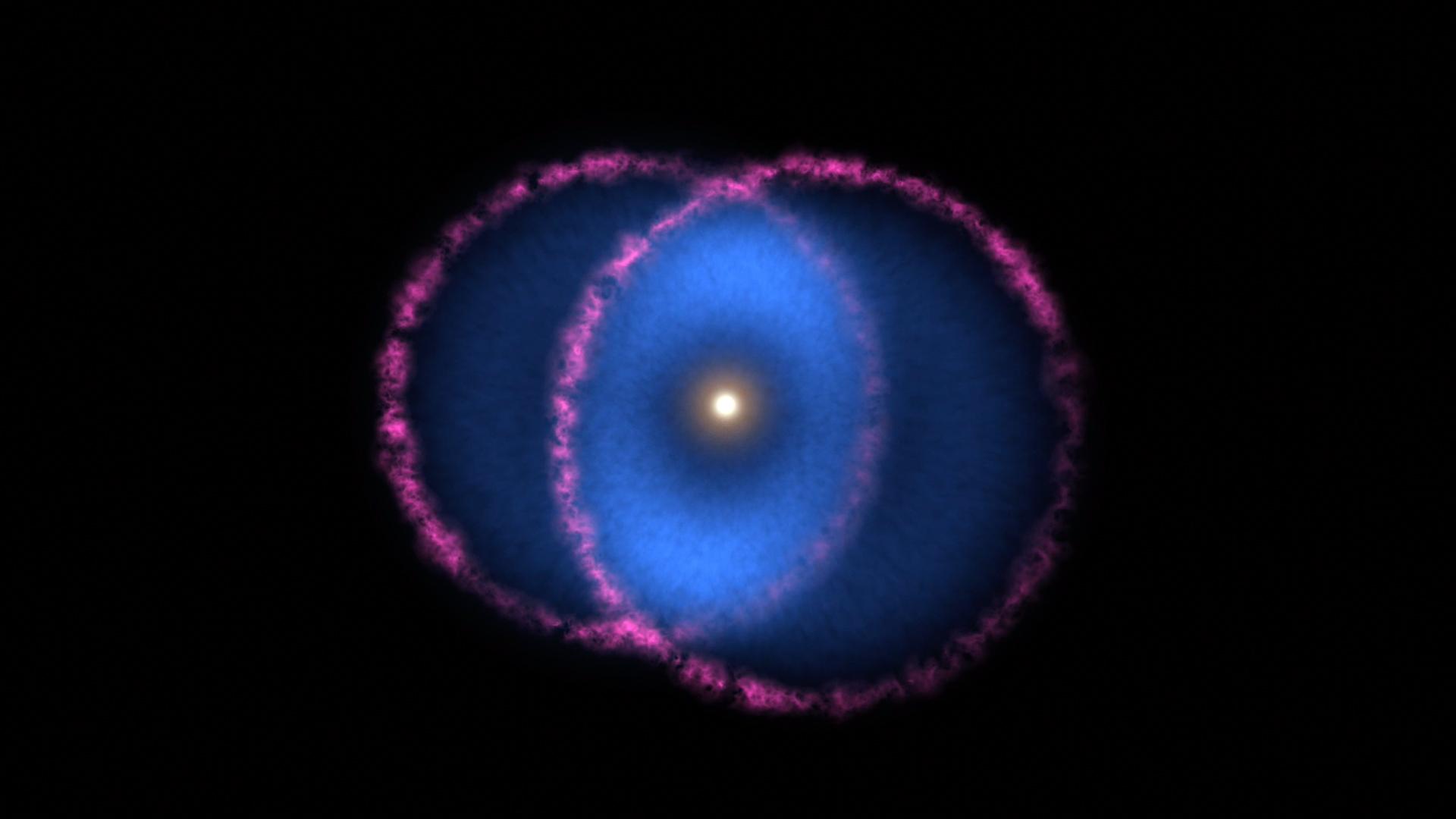
The Blue Ring Nebula is thought to be the product of two stars merging into one. The collision of the bodies ejected a cloud of hot debris into space. A disk of gas orbiting the larger star cut the cloud in half, creating two cones that are moving away from the star in opposite directions. The base of one cone is moving almost directly toward Earth, while the other is moving almost directly away. Magenta represents optical light from the shockwave at the front of the expanding debris cones, outlining the two cone bases at their widest points. Blue represents far-ultraviolet light (not visible to the human eye) and comes from gas behind the shockwave. As the gas expands and cools, it forms hydrogen molecules that interact with the interstellar medium and emit only far-ultraviolet light. These emissions are visible only where the cones overlap (as seen from Earth), forming the blue ring around the central star. Movie available at https://photojournal.jpl.nasa.gov/catalog/PIA23868
Discover nebula-themed journey sites designed for peaceful observation.
Japan, Ogasawara
Stargazing Tour - Observe the best starry sky in Japan, Ogasawara!
ExploreNew Zealand
Small-Group Refined Experience - Stargazing English Tour in Tekapo | New Zealand
ExploreHawaii
Hawaii Big Island: Mauna Kea Stargazing Half-Day Tour with Transfer Service in Waikoloa, Kona, and Hilo
Explore
NASA often uses 'false color' techniques. Scientists map invisible wavelengths (like infrared) or specific gases to visible colors (red, green, blue) to highlight the nebula's structural details.
While some bright nebulas are visible with entry-level telescopes, capturing these stunning details usually requires deep-sky astrophotography equipment and long exposures.


